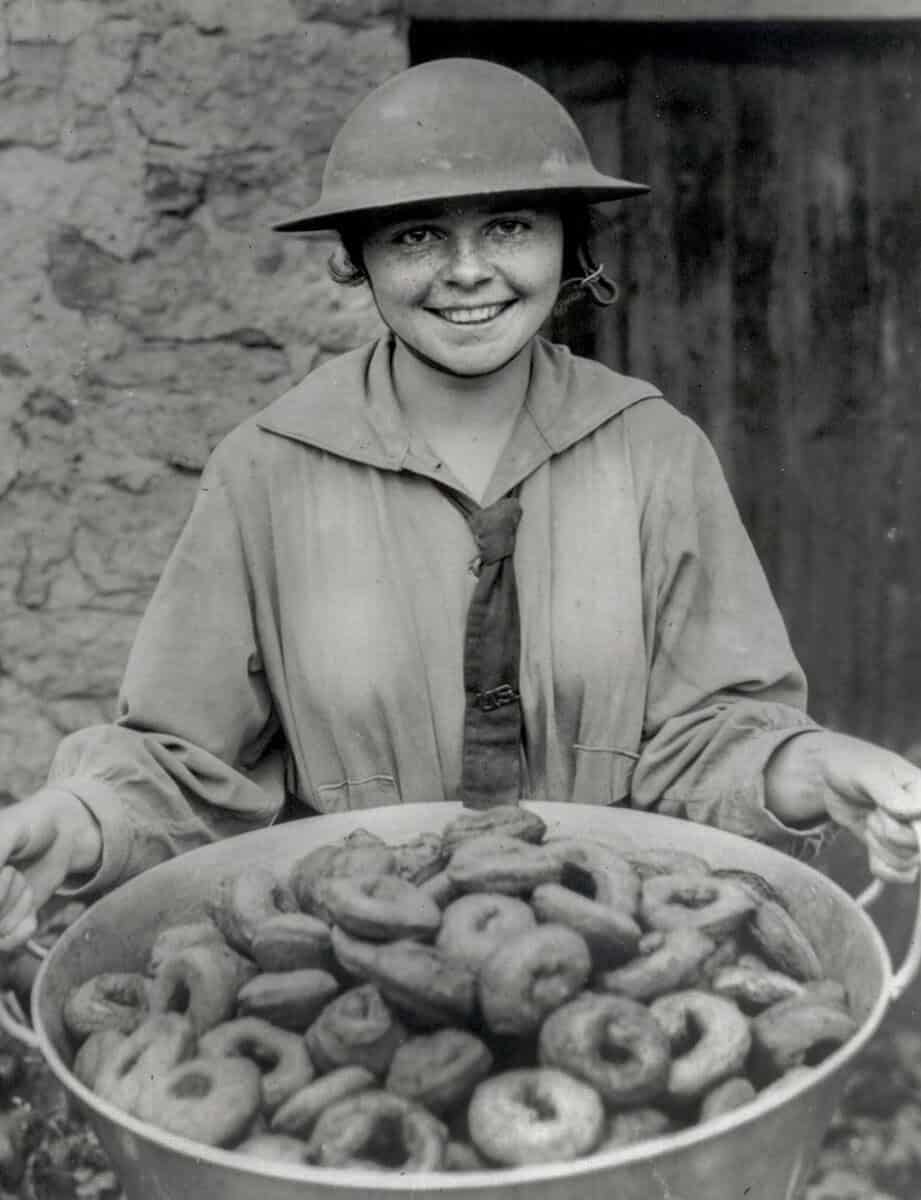

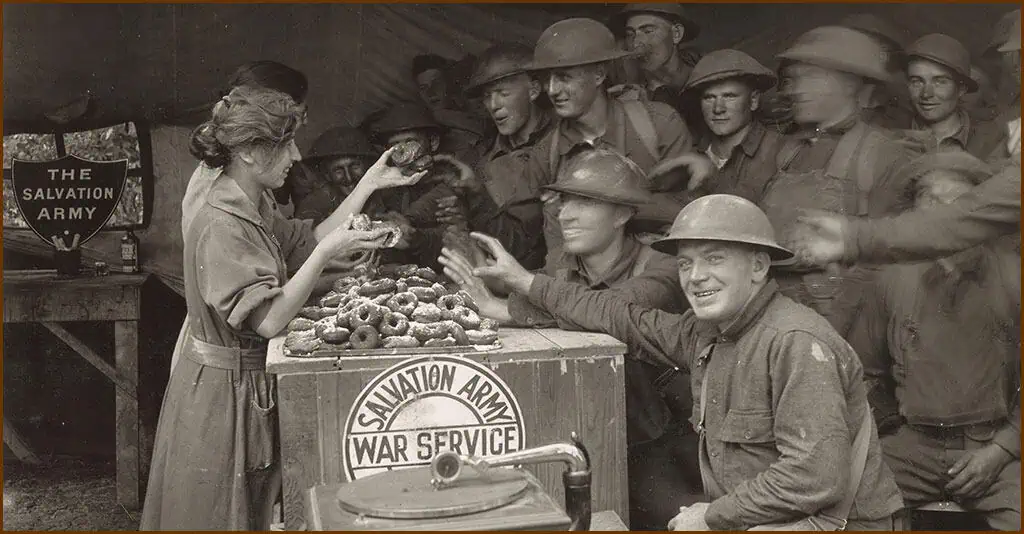
In 1917, the Salvation Army sent 250 female volunteers from its cities and towns to France to boost the morale of troops serving with the American Expeditionary Force on the Western Front, where they braved dangerous combat conditions to provide emotional support. They became known as the Doughnut Girls of World War I, their stories, for the most part, footnotes in America’s wartime history.
Sweet Treats from Improvised Kitchens

The first two Salvation Army volunteers were Helen Purviance and Margaret Sheldon. Soon after their arrival, they had an idea: why not make basic doughnuts to give the fighting men a sweet taste of home?
Working in abandoned or badly damaged buildings, huts, or tents next to the trenches, when blasts shook their “kitchens,” they simply cleaned off the debris and kept going to meet a growing demand.
Lacking the most basic baking tools, the resourceful women used empty wine bottles as rolling pins and shell casings or tin cans to stamp out the soft, doughy circles. Eventually, Purviance approached a local blacksmith who nailed together an empty condensed milk can and shaving cream canister that worked as a mold with the right shape.
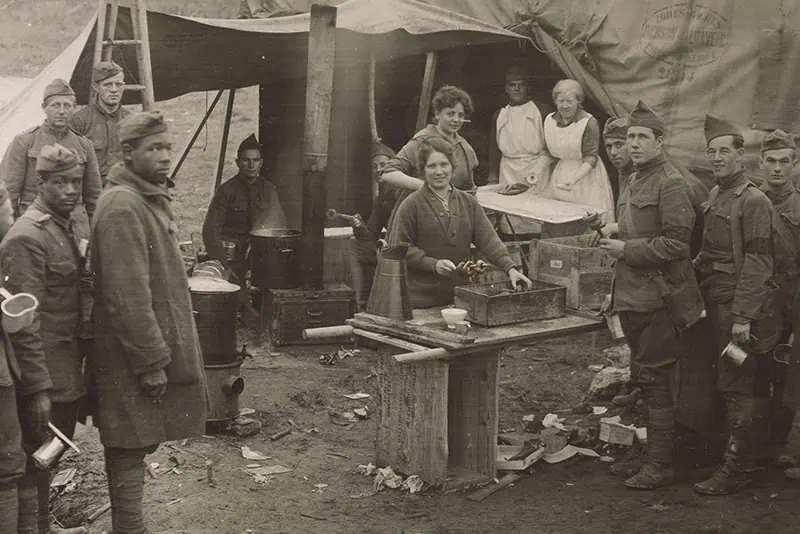
On their first day, the Doughnut Girls fried 150 doughnuts, served seven at a time to each soldier. Demand skyrocketed until, on a typical day, two or three women could make up to 2,500 doughnuts. These simple circles of dough fried in boiling lard were an immediate hit, cementing the Armed Forces’ relationship with doughnuts and the women who made them.
Traveling with the Troops
Moving with the troops to the front lines, they piled supplies into the ammunition train and traveled at night. Not surprisingly, the generals disliked the idea of women being so close to combat; but the ladies were determined in their mission. In the words of Helen Purviance, “General Pershing wasn’t keen about women going close to the front lines. He said he didn’t want to take responsibility for us. We told him he wasn’t. We were taking the responsibility upon ourselves.”
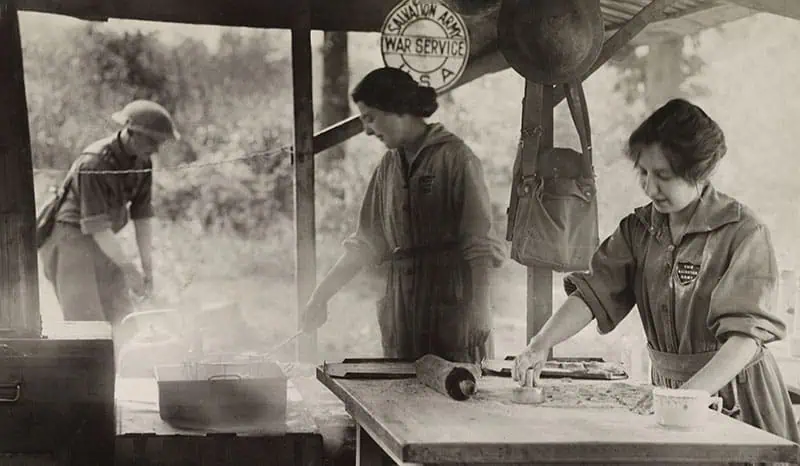
Dresses and Combat Gear
The Doughnut Girls wore uniforms that balanced a professional image with the harsh physical demands of their work behind front lines. Heavy, durable, dark blue woolen dresses had the “Salvation Army” red lettering embroidered on their high collar, while a prominent red patch on the sleeve or chest clearly identified them to troops. A heavy-duty canvas apron went over the dress to protect it from flour, grease and hot lard for frying the dough.
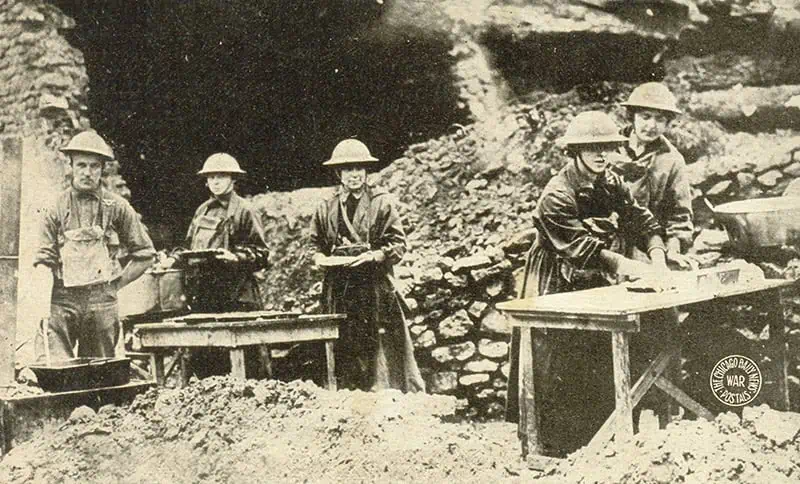
Operating under active artillery fire and near the trenches, they were also issued standard combat protective gear, including a Brodie helmet — a shallow steel helmet with a wide brim designed to protect soldiers from exploding shrapnel falling from above, and a gas mask in a canvas pouch slung over their shoulders or chests in case of chemical warfare attacks. They were also issued .45-caliber revolvers for their personal protection.
Frying Under Fire
When the trenches and huts around them came under heavy artillery fire and gas attacks, the Doughnut Girls refused to abandon their makeshift kitchens. To them, falling back to safer zones would strip the soldiers of hot rations and emotional comfort when it was most needed. They simply donned their gas masks, continuing to cut and fry the dough in their restrictive gear.
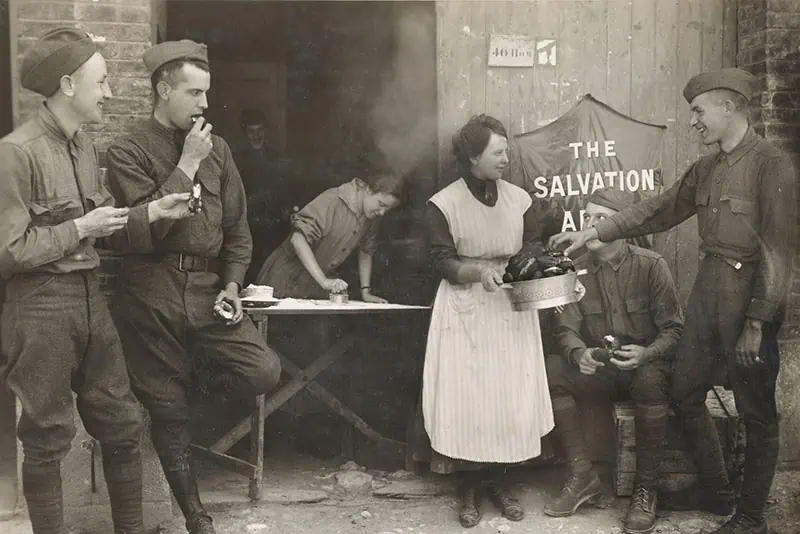
Angels of the Front Lines
Soldiers remembered the Salvation Army Doughnut Girls as angels of the front lines. Watching them endure the same combat conditions as the troops created an intense bond of respect, transforming a simple doughnut into a powerful symbol of home, courage and unconditional support. One soldier marveled, “Can you imagine hot doughnuts…served by mighty good-looking girls, too?” It should be noted that no Salvation Army Doughnut Girls were killed in action during World War I; all 250 of the original volunteers survived the war without a single reported death or major combat injury.
Cultural Legacy
Food historians note that before World War I, doughnuts weren’t very popular in America. But that all changed when the troops came home with a craving for the sweet, doughy treats that drove a surge in the commercial popularity of doughnuts from coast to coast. In remembrance of the original 250 Doughnut Girls, the Salvation Army created “National Donut Day” – the first Friday in June, in 1938, still celebrated to this day. There was even a song written in 1919 about their adventures.
The Doughnut Girls
Helen G. Purviance: Came home with amazing stories and a case of “doughnut wrist” caused by the repetitive strain of rolling and cutting massive quantities of dough—now known as carpal tunnel syndrome. She remembered giving her first doughnut to PFC Braxton P. Zuber of Auburn, AL, with whom she maintained a long stateside friendship. She died in 1984 at 95 years old.

Margaret Sheldon: When not cooking, she sat with the wounded; cut their clothing to save time for the field doctors; rolled cigarettes and took messages for soldiers loved ones back home. Post-war, she had more than 50 messages for those families. She died in 1963.
Stella Young: A published photo of her holding a rolling pin and round dough cutter made her the “All-American” visual symbol of the Doughnut Girls. Once, while mixing dough, she stepped away from her workstation when a shell exploded nearby, sending shrapnel tearing through her hut — a piece of which landed in her frying pan. She plucked it out, cleaned it off, and kept it as a souvenir. She died in 1989, just shy of her 93rd birthday.
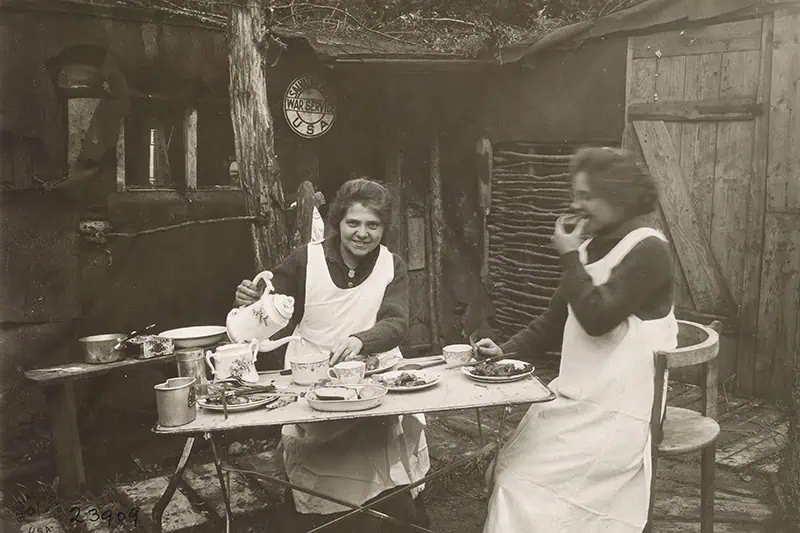
Violet and Alice McAllister: When they weren’t serving doughnuts, they sang, played guitar, set broken bones, administered tetanus shots and comforted the dying. Alice kept a diary, later published as The Doughnut Sweethearts: The Diary of Alice McAllister. She died of natural causes in 1980 at age 88. Her sister Violet returned home to continue her service with the Salvation Army, periodically giving media interviews about her wartime experience. Her life was cut short in 1939 at age 48, when she suffered a cerebral embolism.
Gladys and Irene McIntyre: Known as the “Doughnut Sisters.” General Pershing recommended them and their fellow volunteers for the Distinguished Service Cross for extraordinary bravery in supplying morale-boosting hot doughnuts and coffee to troops on the front lines while under intense artillery fire and gas attacks. Newspapers across America ran their photos alongside battlefield generals, celebrating them as legitimate military heroes.
Original Doughnut Girls’ 1917 Recipe
Yield: 4 doz. doughnuts
5 C flour
2 C sugar
5 tsp. baking powder
1 ‘saltspoon’ salt (¼ tsp or 4 pinches)
2 eggs
1 3/4 C milk
1 T lard
Directions:
— Combine all ingredients (except lard) to make dough.
— Knead dough, roll smooth, and cut into rings less than 1/4 inch thick.
— Heat the lard and drop rings into it, making sure the fat is hot enough to brown the doughnuts gradually. Turn the doughnuts slowly several times.
— Once evenly browned, remove doughnuts, allow excess fat to drip off.
— Dust with powdered sugar. Let cool and enjoy.