

Madame Sophie Blanchard (1778-1819) was a trailblazing French balloonist. While she wasn’t the first woman to take to the skies in a balloon, she was the first to pilot her own customized craft solo, the first to make ballooning a full-time career, and the first killed in an aviation accident.

We know little about her early life. Born in 1778, she was small and petite, standing just 5 feet tall. Her features were often described as sharp and birdlike. She was shy and nervous, loud noises frightened her, and she was terrified of riding in horse-drawn carriages.
In the late 1790s, she married Jean-Pierre Blanchard, the world’s first professional balloonist. By 1804, he had convinced her to fly with him — an experience she described as “an incomparable sensation.” By her third ascent, she was flying solo and, in 1805, became the first woman to pilot her own balloon. Madame Sophie Blanchard became an instant sensation. It wasn’t long before her husband, quick to capitalize on his wife’s growing fame, encouraged her to further develop her aeronautic skills so they could both profit from her popularity.
But in 1809, Jean-Pierre Blanchard fell from his balloon to his death after suffering a fatal heart attack, leaving Sophie with crushing debt and no choice but to make ballooning her full-time profession.
Hydrogen Gas and a Tiny Silver Gondola
She began by choosing a completely different, nontraditional look for her vessel — a tiny, silver, bathtub-like gondola paired with a smaller, lighter balloon.
She eschewed the traditional basket. Tiny, petite, and lightweight, Mme. Blanchard didn’t need the massive wicker baskets her husband had used. She designed a custom gondola “little bigger than a chair” that resembled a small silver bathtub and was just large enough for her to stand comfortably.
She also switched from hot air to hydrogen gas to fill her balloon. Lighter than air, it provided more buoyancy and faster lift. That was important during the era of “balloon riots,” when crowds paid good money to watch launches. If a launch failed because of bad weather or slow inflation, disappointed audiences often rioted, attacking the aeronaut and destroying the equipment. Sophie’s smaller, lighter vessel, coupled with hydrogen gas, allowed her to escape the ground quickly before crowds became hostile.
For the nighttime performances she became known for, wire frameworks were attached below the gondola to hold rows of fireworks, lights, and colored pyrotechnics with slow-burning fuses that she ignited while floating over awe-struck crowds.
She often stood almost completely exposed to her adoring crowds in flowing white dresses and feathered hats specially designed to be visible from a distance, holding the ropes in a pose that highlighted both her vulnerability and fearlessness.
Risky Business
Career balloonist Sophie Blanchard made more than 60 ascents, specializing in daring night flights that often kept her aloft most of the night. The first woman to cross the Alps and traverse Italy by balloon, she reached 12,000 feet, exposing herself to freezing temperatures and risking nosebleeds and fainting. On one trip to Turin, Italy, icicles actually formed on her hands and face.
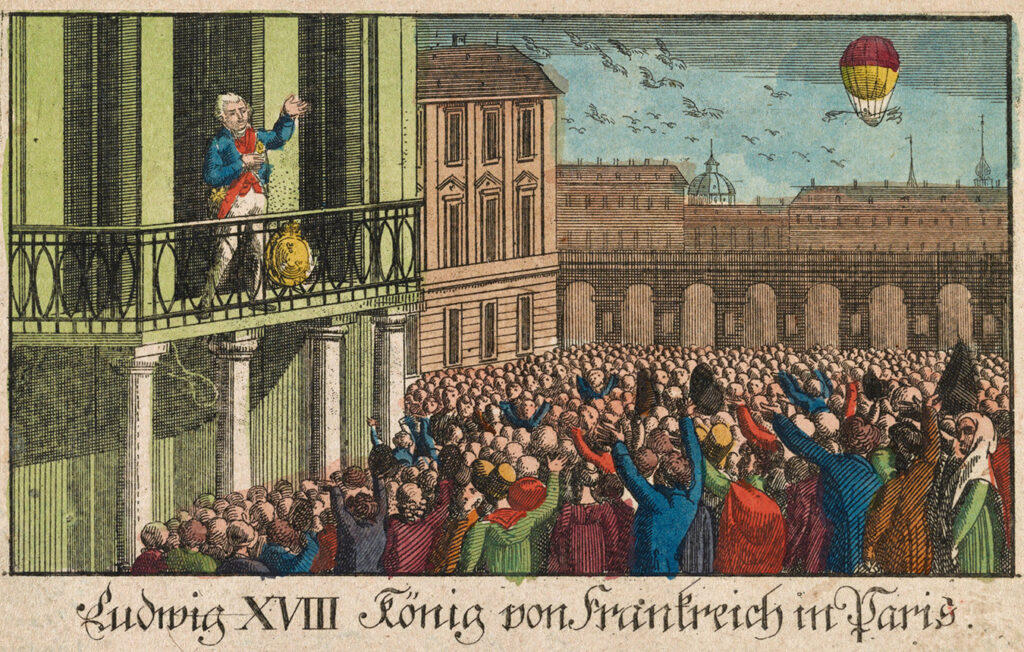
Wherever she appeared, Blanchard drew large crowds. In Germany in 1810, a crowd gathered to watch her take flight while only a few people attended the opening of a new opera. The next year, after ascending high enough to avoid a hailstorm, she lost consciousness and spent 14 hours in the air. On her 53rd flight in 1817, she mistook a marshy field for a safe landing site. As she descended, her balloon became caught in a tree. Her small chair tipped over, leaving Mme. Blanchard tangled in the rigging as she was forced into the marsh. Luckily, many of her admirers on the ground arrived soon after she landed, saving her from a watery death.
A Court Darling
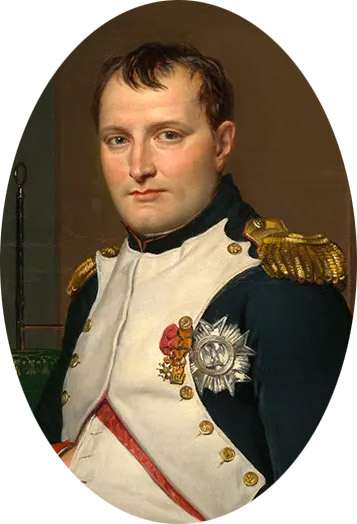
One of her earliest and most enthusiastic admirers was Napoleon Bonaparte. As early as 1804, just after her first flight, he replaced balloonist André-Jacques Garnerin with Sophie Blanchard, naming her “Aeronaut of the Official Festivals.” Garnerin had disgraced himself by losing control of the balloon sent aloft to mark Napoleon’s coronation in Paris. It drifted to Rome and crashed into a lake, making a laughingstock of the emperor.
Napoleon was so taken with Blanchard that he tried to recruit her for an unusual military mission, even naming her “Chief Air Minister of Ballooning.” Her assignment was to map the logistics, determine the size of the fleet required, and test the feasibility of an airborne assault across the sea. After studying the proposal, Mme. Blanchard advised the emperor that the mission was impossible because of the notoriously unpredictable winds over the English Channel, which would make steering an armada of balloons a logistical nightmare. Napoleon accepted her advice and shelved the plan.
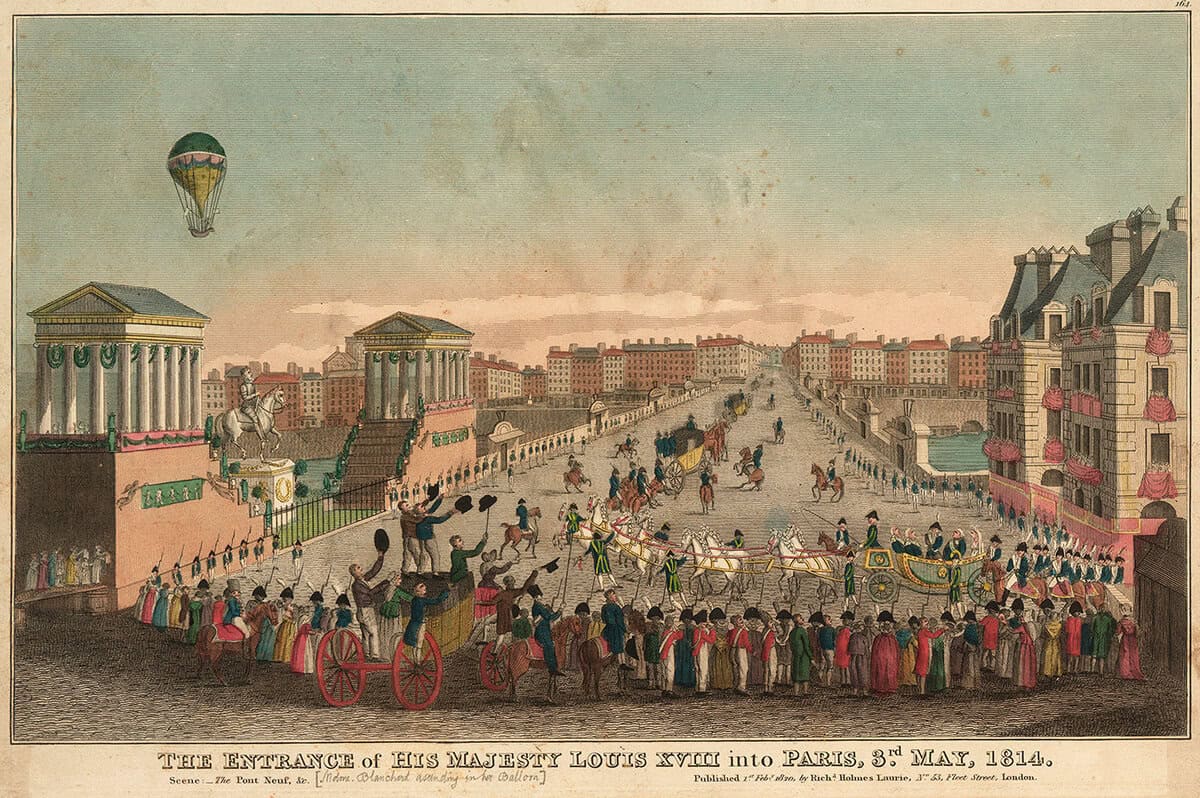
Despite dashing his dream of conquering Britain by air, Sophie Blanchard remained Napoleon’s favorite pilot, designing elaborate aerial displays for his imperial festivals, including his 1810 wedding and celebrations marking the birth of his son. Four years later, after the collapse of the First French Empire and Napoleon’s abdication and exile, King Louis XVIII restored the monarchy and named Sophie Blanchard “Official Aeronaut of the Restoration.”
The Final Fatal First
In addition to her many other historic firsts, Mme. Sophie Blanchard also became the first woman to die in an aviation accident.
In July 1819, she began her 67th ascent at Paris’ Tivoli Gardens. Wearing her signature white dress and hat topped with ostrich plumes, she carried a white flag. As her balloon rose, she began shedding bags of sand ballast. Once aloft, she began her aerial show by waving the flag while her balloon was illuminated by wire baskets containing Bengal lights — slow-burning, colorful pyrotechnics.
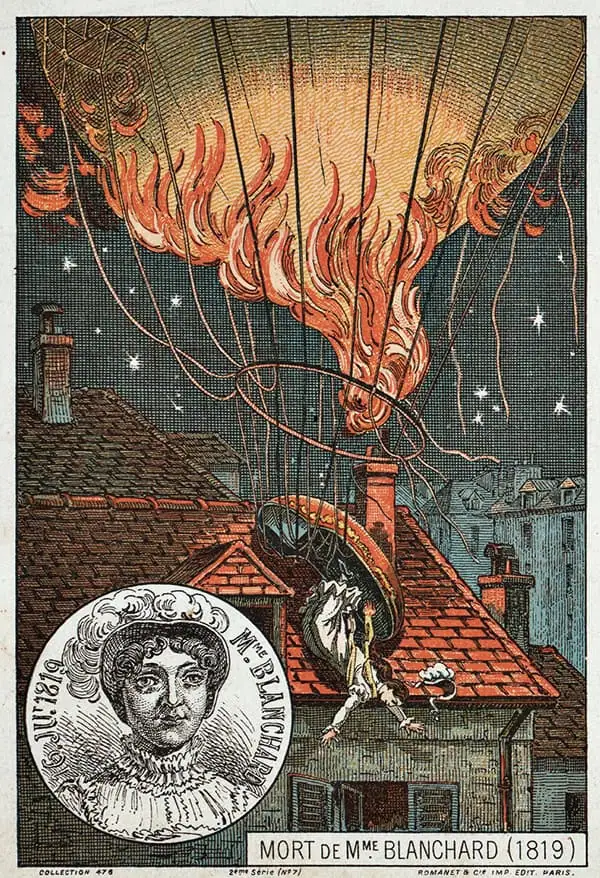
Moments later, horrified spectators watched as the balloon burst into flames after the hydrogen gas ignited.
As Blanchard descended rapidly, the balloon drifted away from the pleasure gardens. Some spectators, believing the fire was part of the performance, applauded and shouted their approval. Then, just above the rooftops of the Rue de Provence, with the balloon’s gas exhausted, the craft struck the roof of a house, throwing Mme. Blanchard from the gondola to the street below. She died from a broken neck.
Eyewitness John Poole later wrote: “There was a terrible pause, then Mme. Blanchard, caught up in the netting of her balloon, fell with a crash upon the slanted roof of a house in the Rue de Provence, then into the street, where she was taken up a shattered corpse.”
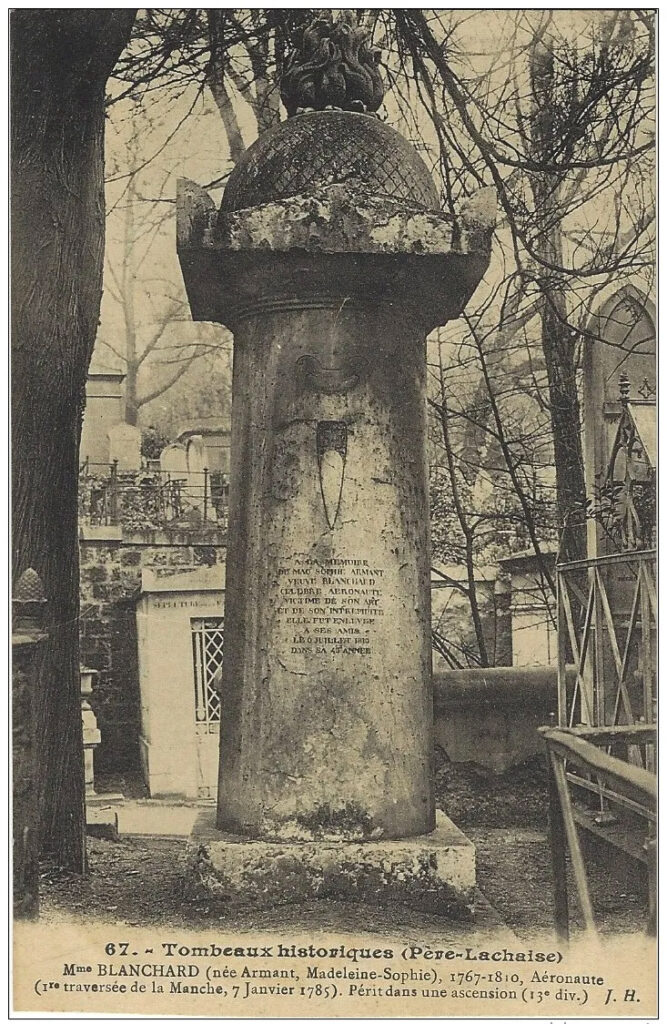
Her plumed bonnet was later seen hanging from the chimney, and one of her tiny slippers remained on the roof. She was buried in Paris’ famed Père Lachaise Cemetery beneath a monument depicting a balloon in flames. Her epitaph reads: “Victime de son art et de son intrépidité” — “Victim of her art and intrepidity.”
Legacy
The story of her death spread throughout Europe. French author Jules Verne referenced her in his first major novel, Five Weeks in a Balloon. Charles Dickens commented on her death with the proverb, “A jug goes often to the well but is pretty sure to get cracked at last,” acknowledging the inevitable risks of her profession. American poet, lawyer, and educator Grenville Mellen portrayed her death as a cautionary tale of a woman exceeding her station — or paying the price of vanity for attempting such spectacular performances — concluding that “a woman in a balloon is either out of her element or too high in it.”
More recently, novelist Linda Donn was inspired by Blanchard’s story to write The Little Balloonist, published in 2006. In 2019, The Aeronauts, starring Felicity Jones and Eddie Redmayne, featured a character partly inspired by Sophie Blanchard’s birdlike, seemingly fragile persona and remarkable fearlessness.
Local Monument to Another Blanchard
Remember Sophie’s husband, Jean-Pierre Blanchard? He was more than a pioneering balloonist and early barnstormer, completing more than 40 flights across Europe and America. On Jan. 9, 1793, he launched a hydrogen balloon from Philadelphia and landed across the Delaware River in Deptford, New Jersey, carrying America’s first airmail letter — an introduction written by President George Washington to the owner of whatever property Blanchard happened to land on, since he spoke no English. Today, a historic marker behind the local Walmart commemorates the achievement.