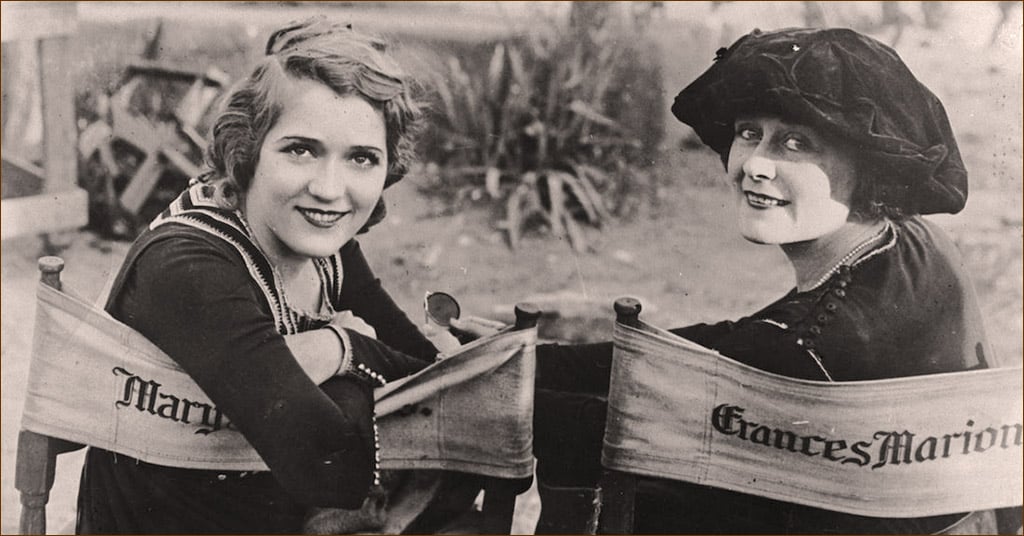
On set at a United Artists film shoot in 1920 are Frances Marion (right) and Mary Pickford (left). Marion, who wrote the scripts for more than 130 films during during Hollywood’s Golden Age, was one of the most highly-paid screen writers of her era.
Google “top 25 greatest screenwriters of all time” and you’ll find every single one of them is a man. But from 1915 into the 1930s, a woman named Frances Marion was the most successful and highest-paid screenwriter in show biz.
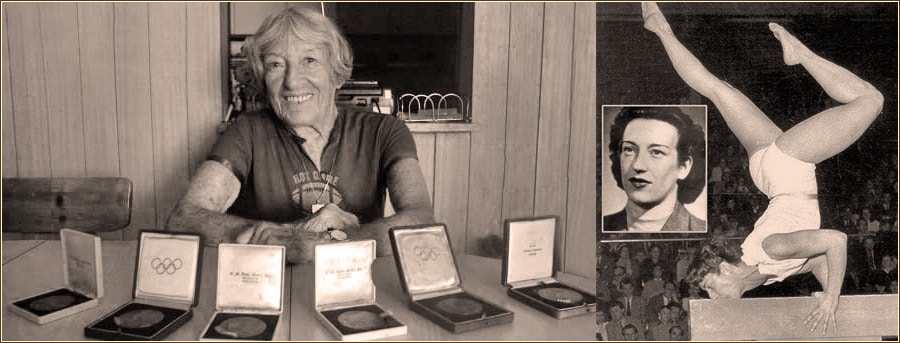
As a 16-year-old rising star in the 1930s, Ágnes Keleti was Hungary’s National Gymnastics Champion. But her life changed dramatically as the Nazi regime enveloped Europe and gave rise to extermination camps. Though she lost her father and other family members to Auschwitz, she survived to achieve stunning international athletic success and relocate to Israel.
As a little girl born in Budapest, Ágnes Keleti dreamed of becoming a cellist. Instead, she saw her father deported to Auschwitz, escaped the Nazis using forged identity papers and, ten years later, became one of the greatest Olympian gymnasts of all time and the most successful Jewish female athlete in the history of the Games.
The second female medical doctor to be licensed in America, Civil War Union Army veteran Mary Walker is also the only woman to ever win the Congressional Medal of Honor.
Mary Edwards Walker (1832-1919) is described as contrary, outspoken, feisty, radical, defiant and determined. But as the first woman to earn the Congressional Medal of Honor, the second woman in America to become a licensed medical doctor, a lifelong women’s rights activist, prohibitionist, and a dress reformer who steadfastly refused to accept the stodgy Victorian confines of her gender, I suspect she earned — and needed — every single one of those attributes.
Smashing racial barriers and wowing audiences on two continents, Florence Mills sang and danced her way into the history of the Jazz Age, leading the way for female African American superstars who came after her.
It was the Roaring Twenties, the anything-goes Jazz Age, when Florence Mills made her mark in American history. Known as the “Queen of Happiness,” she was a cabaret singer, dancer and comedienne known for her effervescent stage presence, unique birdlike voice, wide-eyed beauty and slicked bobbed hair imitated by women on both sides of the Atlantic.
Josephine Silone-Yates was an academic leader in the world of African American schools and pioneer in the field that would later be called STEM education (Science, Technology, Engineering, and Math) for women. Above is the lab at Lincoln Institute where Professor Silone-Yates headed the Chemistry Department.
Josephine Silone-Yates, the first African American certified to teach in Rhode Island public schools, also became America’s first black female college professor and the first black female to head a major college science department. Aside from her role in the field of what would later be called STEM education, she also became a national advocate for the rights of black women.
Pauli Murray as an orphaned teenager, a New York college student sculpted by her friend, and as the brilliant legal mind whose work played a key role in the court challenges of the Civil Rights movement of the 1950s ands 60s.
Pauli Murray may be one of the 20th century’s most important historical figures you’ve never heard of. She was a civil rights activist; a gender rights activist and feminist; a lawyer and brilliant legal strategist; historian, author and poet; and, later in life, an ordained priest.